
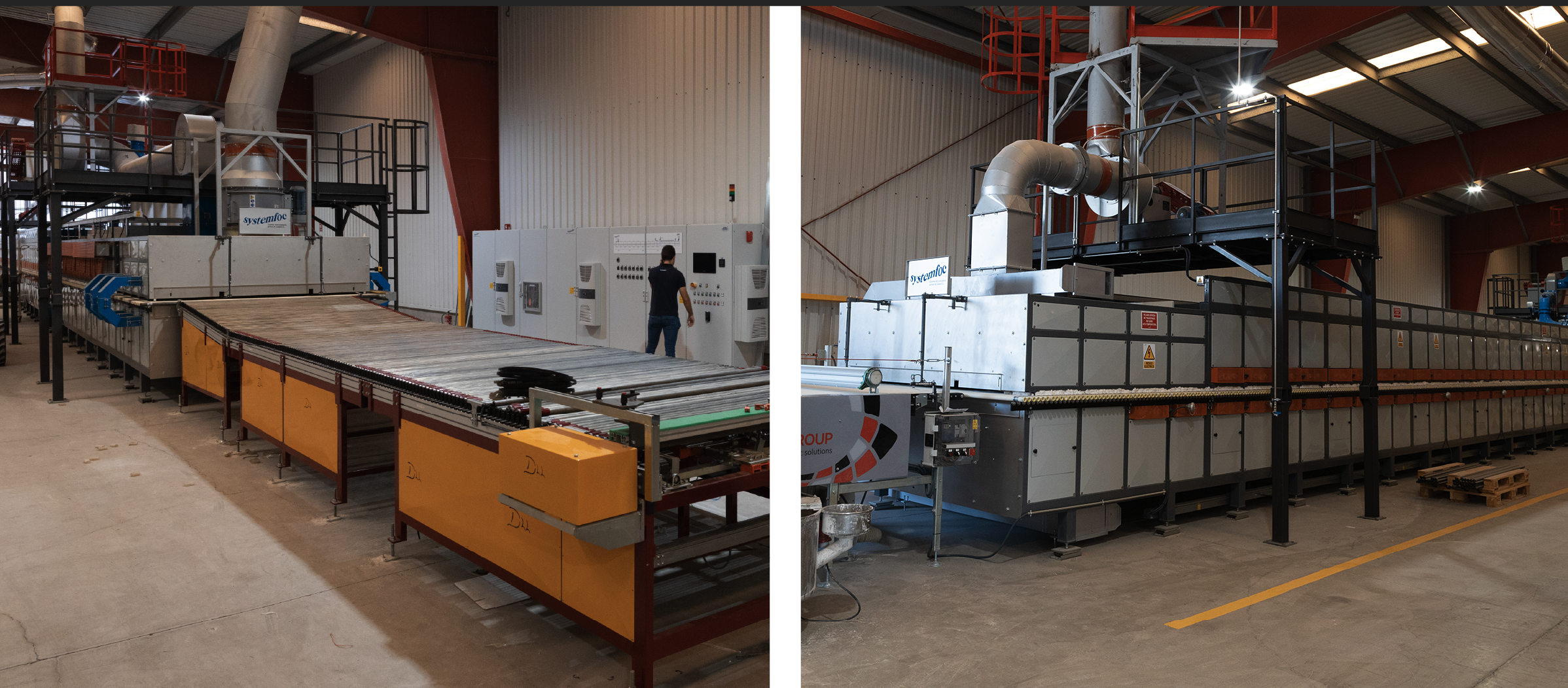
Today, the ceramic industry faces a major challenge: adapting its production processes to a more efficient model that is also more environmentally friendly. In this context, at Systemfoc we firmly believe that competitiveness and sustainability can go hand in hand. For this reason, with the support of the ITC and the backing of Jaume I University of Castelló, we designed and developed our 100% electric kiln, a model that is already delivering its benefits to tile manufacturer Equipe Cerámicas, where it has recently been implemented.
Differences between a 100% electric kiln and a conventional kiln
Below, we explore the main differences between the 100% electric kiln and the conventional kiln. Keep reading to find out.
Energy efficiency: a quantitative leap
One of the most notable aspects of our 100% electric kiln for the ceramic industry is its ability to optimize energy consumption. Unlike traditional kilns, which rely on fossil fuels, the electric kiln uses heating elements that enable precise temperature control. This not only eliminates direct CO2 emissions, but also reduces energy consumption by up to 50% compared to a conventional gas kiln.
Conventional kilns, on the other hand, require large amounts of energy to maintain constant temperatures over long periods. This operating model involves significant heat losses and a considerable ienvironmental impact, consequences that can be avoided thanks to our 100% electric kiln, since, as it does not require combustion air, energy consumption in standby mode (without material passing through) is minimal.
This energy-saving capability compared to gas kilns positions the 100% electric kiln as a gateway to revenue in the form of CAES, in addition to any potential decarbonization grants or energy cost reductions that may be available to us.
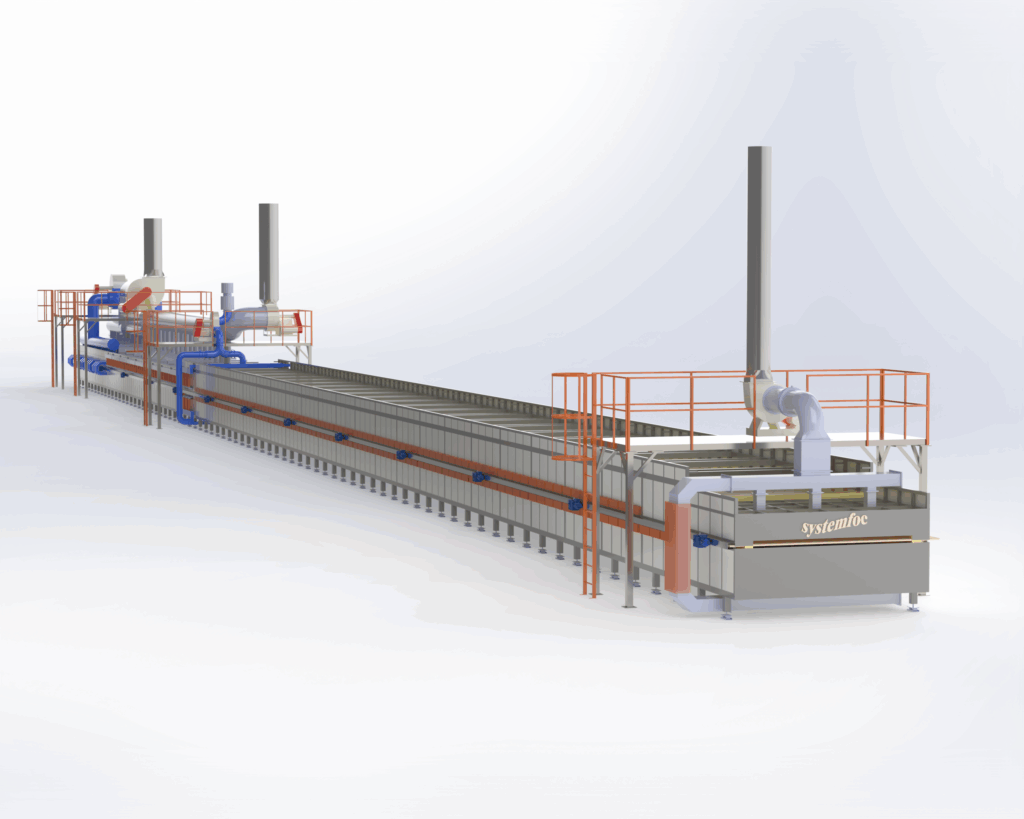
Representation of Systemfoc’s 100% electric kiln
Faster processes: a key advantage
The heating speed of the 100% electric kiln is another differentiating factor. This equipment can reach temperatures of up to 1200°C in just a few hours after a shutdown, while traditional kilns need days to reach the same thermal level. This advantage not only increases productivity, but also reduces waiting time between production cycles, enabling greater operational flexibility.
In the ceramic sector, where demand can vary considerably, having a system that quickly adapts to production requirements is essential. In this regard, our 100% electric ceramic kiln meets this need, marking a turning point in time management and making it possible to do without the night shift, facilitating work-life balance and staff recruitment.
Final product quality: uniformity and precision
Final product quality is another area where the 100% electric kiln stands out. As we mentioned in our latest blog article, thanks to uniform heat distribution, cold or hot spots that are common in traditional kilns are eliminated. This ensures uniform firing, resulting in higher-quality ceramic pieces and a lower defect rate.
But that is not all. Its advanced cooling system guarantees material stability at all times, ensuring a uniform cooling process that is also fast and controlled, while allowing the internal kiln atmosphere to be cleaned.
In conventional kilns, variability in heat distribution can create inconsistencies that affect the pieces’ physical and aesthetic properties . This problem, which increases costs associated with waste, is effectively solved with the electric kiln’s advanced design.
Sustainability and decarbonization: an unavoidable commitment
Decarbonization in ceramic production is a priority objective for the ceramic industry, and the 100% electric kiln from Systemfoc represents a significant step in this direction. By eliminating the use of fossil fuels, this equipment directly contributes to reducing greenhouse gas emissions, aligning with the most demanding environmental regulations.
In addition, lower energy consumption and the ability to integrate with renewable sources reinforce its sustainable profile, positioning it as an ideal solution for companies seeking to innovate and remain competitive without compromising the environment.
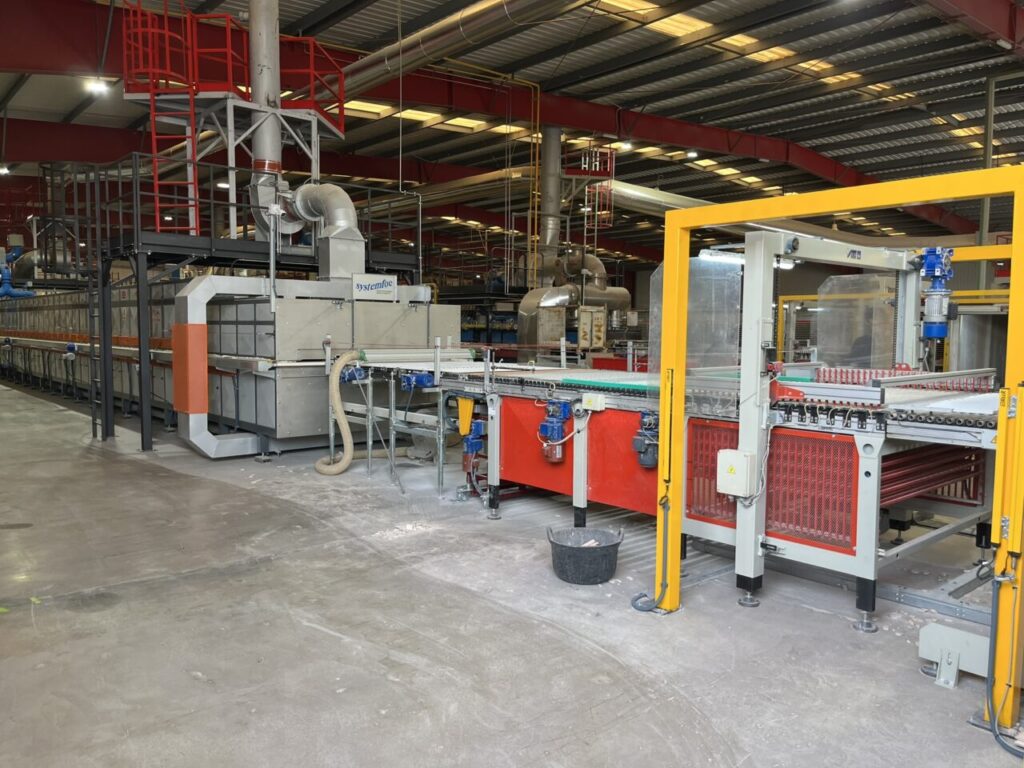
Installation of a 100% electric kiln at Equipe Cerámicas
Other benefits of the 100% electric kiln
Having mentioned all of the above, it is worth highlighting other aspects that consolidate our 100% electric kiln as the most efficient and cost-effective alternative.
We are referring mainly to its ease of repair and maintenance, since its components are easily interchangeable and “km 0”, which minimizes downtime in the event of a breakdown.
In addition, it has locally available spare parts, which makes them easier to obtain and reduces logistics costs. Specifically, the kiln’s heating elements can even be repaired among themselves, which extends the equipment’s service life and optimizes performance efficiently and cost-effectively.
In short…
The differences between Systemfoc’s 100% electric kiln and traditional models lie not only in its advanced technology, but also in the positive impact it has on efficiency, profitability, and final product quality. This equipment not only improves production processes, but also addresses the urgent need to move towards a more sustainable industrial model.
Investing in advanced industrial designs and developments that prioritize decarbonization in ceramic production is not only a responsible choice, but an essential strategy to ensure competitiveness in an increasingly demanding market.