
The ceramic industry is experiencing one of the most complex energy periods of recent decades.
International geopolitical tensions, energy market volatility, and recent spikes in gas prices have once again brought a key issue for industrial competitiveness to the forefront: energy stability.
For years, gas has been the dominant fuel in ceramic firing processes. However, the current context is forcing many companies to rethink their energy strategy. This is not only for sustainability or regulatory reasons, but due to an increasingly critical issue for the industry: predictability.
In this scenario, industrial electrification, and particularly the implementation of the 100% electric kiln in the ceramic industry, is beginning to consolidate as a reliable, efficient alternative prepared to operate at an industrial scale.
The scale-up of the electric kiln in the ceramic industry
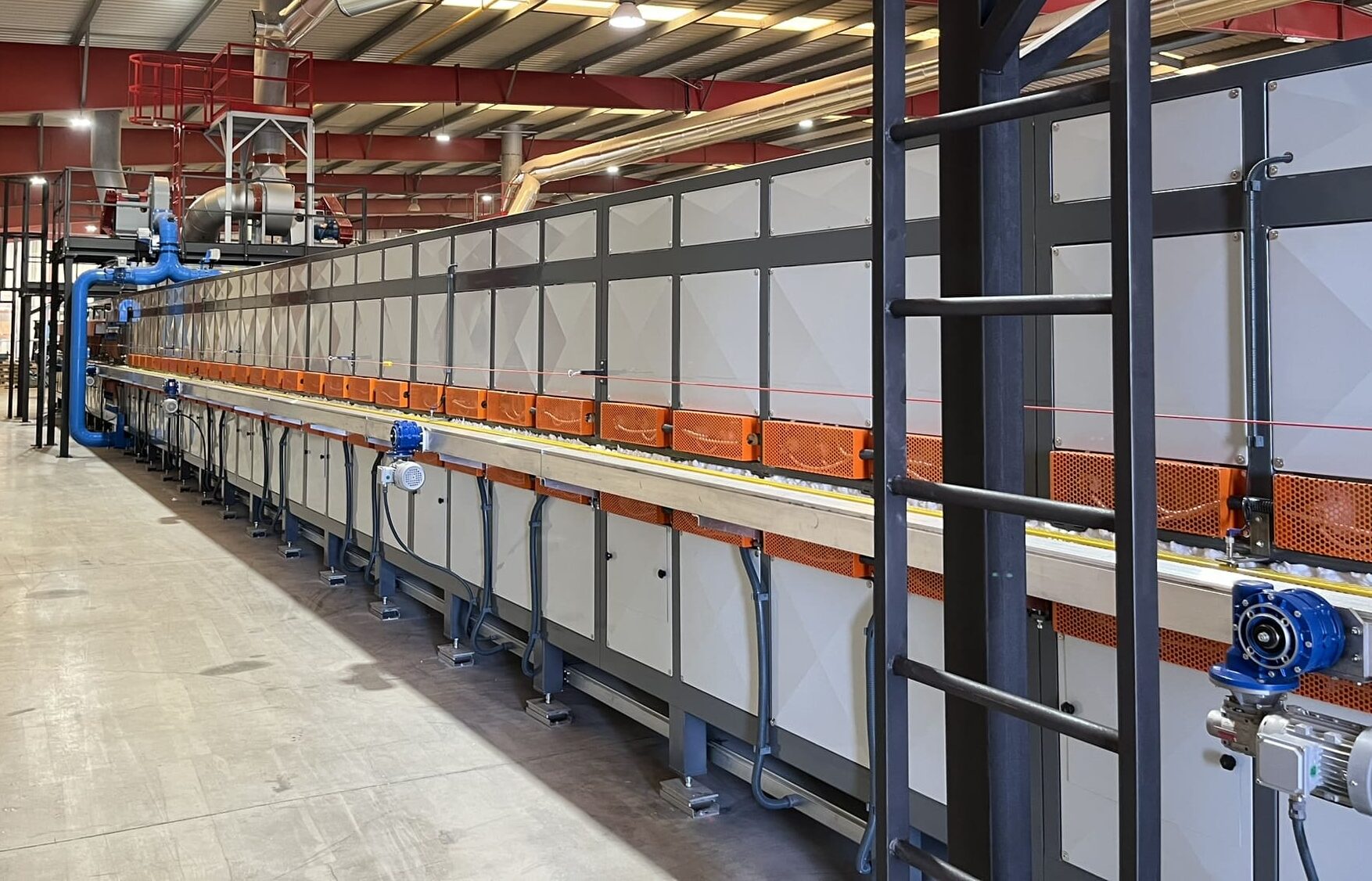
The new 100% electric kiln from Equipe Cerámicas represents precisely that leap forward.
With a length of 60 meters and a production capacity of up to 3,500 m²/day, this new equipment marks a significant milestone in the evolution of ceramic firing electrification.
However, doubling the scale of an electric kiln is not simply a matter of replicating a previous design.
It involves addressing new technical challenges:
- Thermal management in large production volumes
- Process stability in continuous operation
- Precise control of heat distribution
- Maintenance of product homogeneity
At this scale, the true challenge is no longer proving that the technology works, but ensuring that it does so with stability, efficiency, and reliability.
When technology operates in real production
In continuous thermal processes such as ceramic firing, small deviations in heat distribution can result in variations in quality, energy consumption, or production stability.
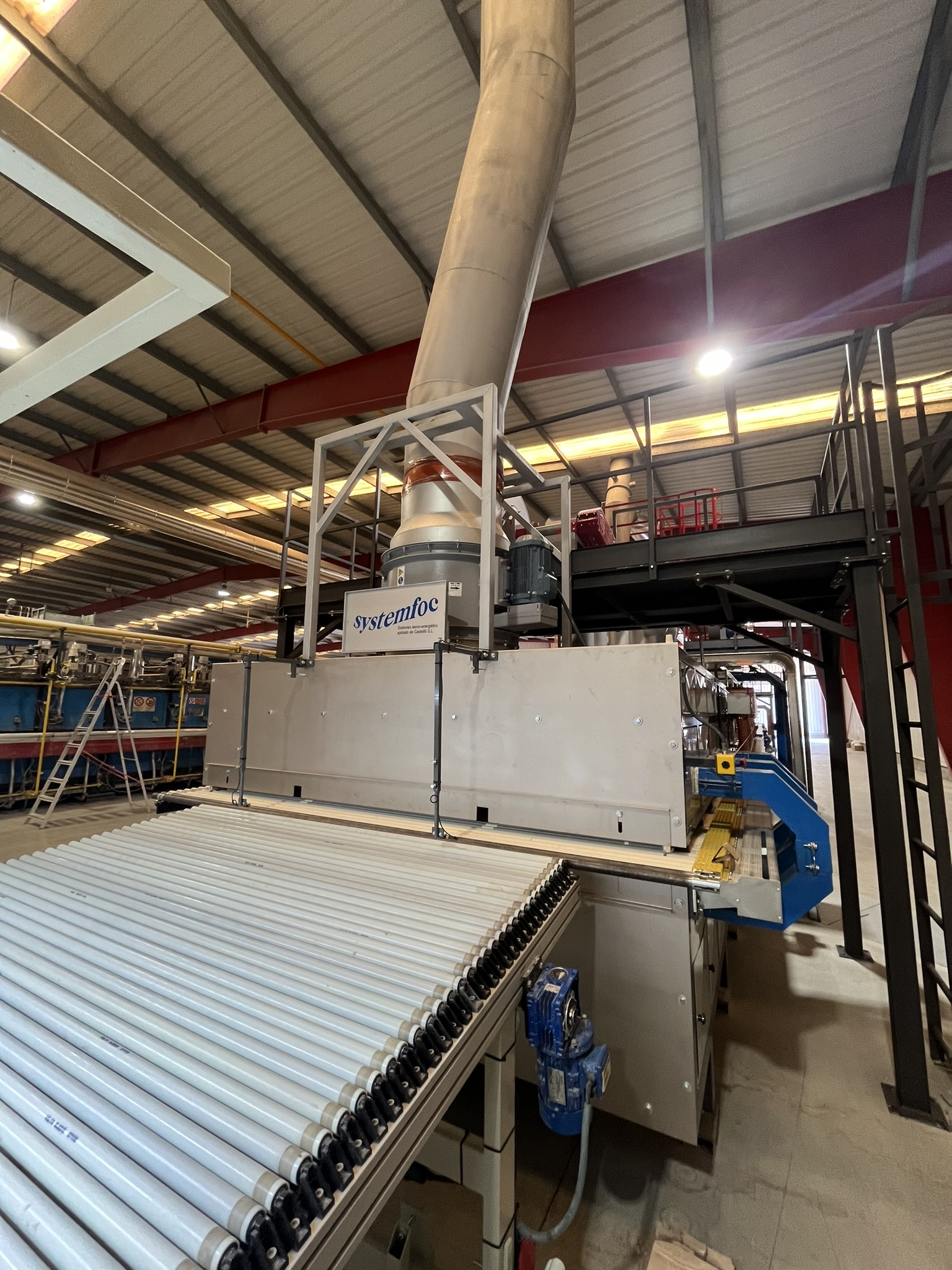
Based on the experience accumulated by SYSTEMFOC in industrial electrification solutions, the 100% electric kiln design stands out for its comprehensive approach, which takes into account:
- The thermal architecture of the equipment
- The distribution and control of heating elements
- The stability of the firing curve
It is a matter of reconfiguring the thermal behavior of the kiln to guarantee stability and efficiency under real industrial conditions.
This approach is what allows electrification to move from being a technological project to becoming a production infrastructure capable of operating continuously in the ceramic industry.
Industrial robustness: the true test of technological maturity
In industry, the maturity of a technology is measured by its ability to operate stably over long production periods.
For this reason, the 100% electric kiln guarantees:
- Thermal stability, maintaining constant firing curves.
- Operational stability, avoiding process deviations.
- Product homogeneity, regardless of production volume.
- Production repeatability.
- Robustness in continuous operation.
It is this operational consistency that marks the difference between an emerging technology and a mature solution.
Electrification and energy efficiency in a context of gas volatility
The current energy context further reinforces the interest in electrification and energy efficiency solutions.
Dependence on fossil fuels exposes the industry to external factors that are difficult to control: geopolitical tensions, fluctuations in energy markets, or regulatory changes.
Greater stability in energy supply allows for improved industrial planning, facilitating decision-making in key areas such as production scheduling, energy consumption forecasting, or production capacity optimization.
When energy ceases to be an unpredictable variable, companies can operate with greater security in planning their processes and in the management of their industrial activity.
In an environment marked by energy uncertainty, this planning capability plays a crucial role in strategic decision-making.
From technological alternative to industrial infrastructure
The evolution of the 100% electric kiln in the ceramic industry reflects a broader transformation in the industrial energy model.
The electrification is no longer just a bet on the future.
It is establishing itself as an energy infrastructure capable of operating at an industrial scale, maintaining process stability, energy efficiency, and production competitiveness.
The new electric kiln that will soon be implemented at Equipe Cerámicas represents precisely that turning point.
An example of how a technology that was considered emerging just a few years ago is beginning to be seen as a mature industrial solution.
In an increasingly uncertain energy context, the ability to combine energy efficiency, operational stability, and industrial predictability will be one of the factors defining the competitiveness of the ceramic sector in the coming years.
The electrification of the firing process is beginning to prove that it has much to contribute to that equation.
If you would like to learn more about the 100% electric kiln or analyze its application in your plant, the SYSTEMFOC technical team will be happy to study your case.